


To enter into the spirit of the Assumption there is one door and one key: the Kingdom of God and the love of Jesus Christ. Father Emmanuel d’Alzon, our founder, gave us two mottos for entering and breathing deeply with both lungs:
“Thy kingdom come”
“Because of the love of Jesus Christ”.
What do we remember about the charism of Emmanuel d’Alzon, declared venerable by John Paul II in December 1991? How original is it to take as our calling card the quotation from the Our Father: “Thy kingdom come” (Adveniat Regnum Tuum, ART) in us and around us? Fr. d’Alzon invites us to focus on what’s essential: the love of Jesus Christ, the Blessed Virgin and the Church: this triple love is expressed in the present: we’re talking about social, doctrinal and ecumenical accents, inspired by Saint Augustine, around charity, truth and unity.
175 years after the founding, these familiar traits have found their place in new territories and cultures. In all, 10 religious branches have emerged from the inspiration of Emmanuel d’Alzon and his successors. From the south of France to its origins on five continents, the spirit has taken shape.
This is the fundamental character of our congregation!
Christ our strongest reason for living

Called by him
Called and sent by him, we want to follow him radically, letting his life shape our own in the unity and communion so strongly emphasized. Our prayer and action are modelled on his. Like him and with him, we want to be witnesses to the Father’s love and to be in solidarity with mankind, to be men of faith and men of our time. Then, loving as he did, we will vibrate to the joys and dramas of today, and joyfully bear witness to Reconciliation in Christ, inseparable from the promotion of all mankind.
Behind him
We are called to radically follow Christ along the paths of the Gospel. Under the action of the Spirit and following the example of Mary, we choose to risk our lives in the adventure of encountering God. We recognize in Jesus Christ the perfect man, and find in God our strongest reason for living and acting. He wants to make everyone his people, his friends, his sons.
Like him
Following Christ, totally at the service of the Father, we choose celibacy for the sake of the Kingdom. We direct all the love we can give and receive towards God. The more we love as Christ does, the more we’ll be able to live our human relationships under his gaze, and the more sensitive we’ll be to the joys, sufferings and concerns of others. Our obedience is rooted in Christ’s obedience. His fidelity to the Father and his love for mankind led him to the total gift of himself. He came to serve, and became obedient to the point of death.
Brothers in him
Called by Christ, the source of all unity, we choose to live together according to the Rule and spirit of St. Augustine, in view of the Kingdom. The coming of Jesus Christ’s reign for us and our neighbors is already taking place in our life together. We accept that we are different, because the One who unites us is stronger than what separates us. We must constantly rise above our divisions and limitations to find each other again in acceptance and forgiveness.
Praying with him
Our prayer is expressed in praise to the Father for the revelation of his love, and in thanksgiving for what he does in us and in mankind. It also leads us to ask, for the world and for ourselves, for his forgiveness and the strength to carry out his will. In return, prayer gives us filial intimacy with God, strength in faith and generosity in action. The Eucharist is at the heart of it all.
The Kingdom of God
Our motto: Adveniat Regnum Tuum (ART) – Thy Kingdom Come
This request, this cry, this hope are those of every Christian who prays to the Father. There is a relative simplicity here, a motto that is not the “property” of the Assumption, but in which every Christian can recognize himself. It reflects the Assumption’s ambition: to be at the heart of the Church and the world.
Our founder, Emmanuel d’Alzon, summed up his intuition as follows:
“Our spiritual life, our religious substance, our raison d’être as Augustinians of the Assumption, is to be found in our motto Adveniat Regnum Tuum: the coming of the Kingdom of God within us and around us”.
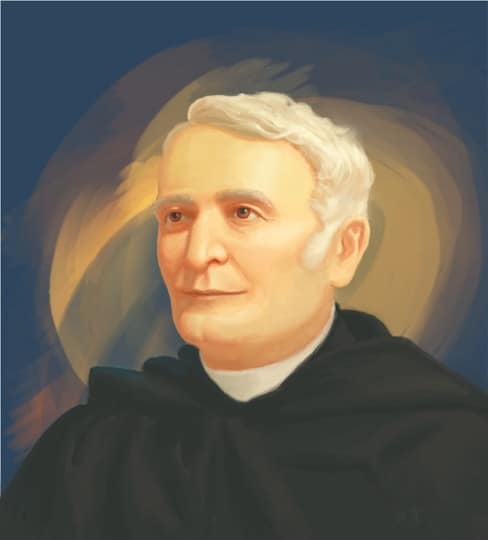
Bruno Chenu was an Assumptionist and theologian. He placed our founder and his motto “Vienne Ton Règne! in the light of contemporary theology. In this way, he invited the apostolic religious, passionate about the Reign of God, to also be a watchman waiting for the Reign, and a gardener of the Reign.
Passionate about the Reign of God
For Fr. d’Alzon, the Reign of God in us and around us is the twofold aspect of personal sanctification and universal evangelization. But contemporary theology is developing a theology of the Reign of God that is more immediately biblical and unquestionably prophetic.
Prophet of the Kingdom of God
In the First Testament, the prophet focuses primarily on the present. He evaluates the present by referring to the past of the Covenant and announcing the future, which can be radiant or calamitous, depending on the faithfulness of God’s people. Apostolic religious life, on the other hand, starts from the future and the ultimate future. This is what we call the “eschatological” dimension of religious life. Religious remember the end. They live in hope. They cannot be satisfied with the “already there” of the Kingdom of God. They long for the time of fulfillment and transfiguration of the world.
Watchman, waiting for the Kingdom
From that moment on, the religious is on the watch, waiting for the One who is coming. His homeland is the heavenly Jerusalem. “Our city is in heaven”, he says with the apostle Paul (Philippians 3:20). And the vows of religious life are first and foremost understood in this perspective. Through their lives and words, they are an invitation and sometimes a provocation for all to serve the Lord with total and gratuitous purity, in fidelity to the pact of love. They restore the value and memory of God’s original plan (obscured by sin), and are a sign of the impatience with which all humanity awaits the full revelation of the Son’s glory (cf. Rom 8:19-21). Compared to the laity, religious are more attested to the “to-be” dimension of God’s Reign. They precipitate the future into the present. They “presentify” the future Reign. There is nothing more urgent than “seeking the Kingdom of God and his justice” (Mt 6:33). Deep down, men and women have been seized by God’s beauty. So they thought they didn’t have too much of their whole lives to sing this beauty in action and/or contemplation, word and/or silence, solitude and/or fraternal life. The contemplative dimension is therefore not reserved for those we call “monks”. It belongs to the essence of apostolic religious life.
Gardener of the Kingdom
But turning our gaze towards the end does not mean taking a break from history. The present is the time of the Incarnation of the ultimate. For waiting is active. That’s why religious are so committed to the Kingdom that they want to detect and nurture its seeds in their present lives, through work and mission. He is a gardener of the Kingdom. His heart expands to the vast spaces of God’s action in history. Hope, drawing man forward from himself, always has an important impact on everyday life, at a time when people are struggling to build a future of peace and solidarity. Our Western world needs hope therapy if it is to find meaning in its existence.
The love of The Blessed Virgin Mary

Fr. Emmanuel d’Alzon summed up the spirit he intended to imbue in his congregation in a powerful phrase. It could be stated as follows: to work for the coming of the Kingdom, by loving Christ and what he loved most, Mary, his mother, and the Church, his spouse. In our religious families, we have been strongly marked by the seal of this “triple love”.
Father Emmanuel d’Alzon explicitly wished to place his congregation under the tutelage of Our Lady of the Assumption, by giving us “The Constitutions of the Augustinians of the Assumption”.
Many of her nascent works flourished under Mary’s protection: the Collège de l’Assomption in Nîmes, the cradle of the congregation, the association Notre-Dame-de-Salut, the first novitiate of the Oblates of the Assumption in Le Vigan, Notre-Dame de Bulgarie, the first alumnat Notre-Dame des Châteaux, a source of many vocations.
Father Emmanuel d’Alzon was delighted when Pope Pius IX proclaimed the dogma of the Immaculate Conception in 1854. He was secretly, but not impatiently, hoping for the proclamation of the mystery of the Assumption.
Together with his pupils, teachers and brothers, he was a regular visitor to pilgrimage sites in and around his diocese: Notre-Dame de Rochefort, Notre-Dame de Grâce, Notre-Dame de Bonheur à l’Espérou. He liked to stop off at Notre-Dame des Victoires in Paris, Notre-Dame de Fourvière and Notre-Dame de la Garde. Without rushing events, did he not go to La Salette, then to Lourdes, ten years after the apparitions?
In all these places and in the contemplation of the various mysteries of Mary, Fr. Emmanuel d’Alzon finds the Virgin of the Gospels, docile to the Word, available to God’s plan for humanity, present, discreet, at the crucial turning points in the life of her Son, standing at the foot of the Cross, assiduous in prayer, in the midst of the disciples, awaiting the Spirit. “To know the Blessed Virgin, the Gospel is enough” This suits us perfectly.
The few echoes that have come down to us of Mary’s prayer in the Gospels are humble acquiescence, amazed praise and absolute trust. Fr. d’Alzon was largely imbued with them. Without the slightest reluctance on our part, they could fertilize our own impulse to pray as servants of the Kingdom.
Love of the Church
Called by Christ, the source of our unity, we choose to live together according to the Rule and spirit of Saint Augustine, with a view to the Kingdom!
Serving the Church
For Augustine, community is not an end in itself. It only makes sense to foster the search for God and apostolic life. The Augustinian community thus has a profoundly ecclesial vocation. As Father André Brombart, an Assumptionist, points out, this vocation is not external or additional. Whatever the “works” in which it expresses itself, it is fundamentally about creating and sustaining a wider “community fabric”. That’s why communal harmony is the best witness to the Good News we proclaim. “If you have love for one another, everyone will know that you are my disciples” (Jn 13:35). Personally, Augustine would have preferred a life of seclusion, devoted to the search for God.
But he did not shy away from the needs of the Church: “the cleric has made a profession of two things, he has embraced holiness and clericity: holiness for the interior, for it is with a view to his people that God makes a cleric…”. (Sermon 355, 6). He wanted to communicate his passion for God and for man.
We too must stop and look at our world. Let us separate the wheat from the chaff. Deeper still, let us discover Christ in it. “See the Lord, see him who is your head and the model of your life” (Sermon 296, 6). By leaning on him, leaning on one another, with our eyes fixed on heaven, we’ll have a better chance of giving everyone a taste of “the time of mercy”. To share fully in the life to come, let’s concentrate on the present. Let us have no other desire than to communicate the joy of living as brothers and sisters in reconciliation. Have we recognized the source of all beauty? Let’s share it in the Church, with everyone!