

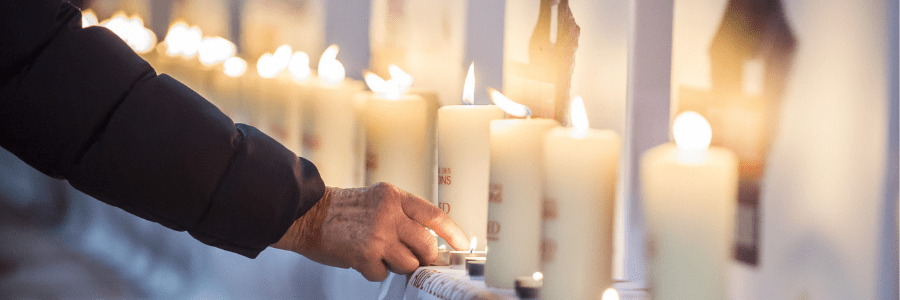
Our blessed martyrs of Bulgaria: Kamen, Pavel and Josaphat
On November 11, 1952, at 11:30 pm, in the central prison of Sofia, the capital of Bulgaria, three Bulgarian Assumptionist monks, Fathers Kamen Vitchev, Pavel Djidjov and Josaphat Chichkov, were shot. At the same time, a Bulgarian Passionist bishop, Eugène Bossilkov, was also shot. The sentence was passed on October 3, condemning the four men to death in a trumped-up trial on charges of spying for the Vatican, attempted conspiracy and being henchmen of capitalism.
Pope John Paul II beatified Archbishop Bossilkov in Rome on March 15, 1998, then traveled to Plovdiv, Bulgaria, to beatify the three Assumptionist martyrs on May 26, 2002. He emphasized the strong ecumenical symbolism of these martyrs belonging to both the Latin and Byzantine rites of the Christians of this country, the first Christianized Slavic state (864), which gave the Slavs their most ardent evangelizers: the two holy brothers Cyril and Methodius.
Who are the three martyrs in Bulgaria?
Kamen Vitchev (1893- 1952)
Born on May 23, 1893, in Srem, Bulgaria, into a very Christian peasant family, two of whose six sons were to become Assumptionist priests, little Kamen Vitchev was baptized under the first name of (Petar) Pierre and only changed his first name to Kamen, as was then the custom in the Assumptionist Congregation, when he entered the novitiate in Gempe, Belgium, on September 18, 1910.

He had previously attended the minor seminary at Karagatch, near Andrinople and Phanaraki, on the Asian shore of the Sea of Marmara. On leaving the novitiate, the young Karnen, judged pious, serious and hard-working, was sent to Louvain, Belgium, to study philosophy and theology, interspersed with teaching internships at St Augustin’s College in Plovdiv and the alumnate (minor seminary) in Koum Kapou.
He was ordained a priest in Constantinople on December 22, 1921, in the Eastern Rite. Back in Europe, he studied theology in Strasbourg and Rome… He obtained his doctorate in theology in Strasbourg in 1929. An excellent connoisseur of Bulgarian church history, he published several studies in the magazine “Echos d’Orient”.
In 1930, he was appointed professor of philosophy and prefect of studies at the Collège Saint-Augustin in Plovdiv, until the college was closed by the Communist authorities on August 2, 1948. All Fr. Kamen’s pupils remember him with emotion, respect and gratitude. It’s true that this great Assumptionist college had become the flagship of Bulgarian intelligentsia. It welcomed young Orthodox, Catholics, Armenians, Jews and Muslims without distinction. All lived in perfect harmony without denying their faith. It was an extraordinary ecumenical success story. Such an establishment, which was also a credit to French culture, soon came under fire from the Communist regime.
With the college closed, Fr. Kamen became Superior of the seminary in Plovdiv , where fifteen religious, five theology students and fourteen seminarians were housed under the same roof. In 1949, all foreign religious were expelled from Bulgaria, and Fr. Kamen was appointed Vicar Provincial of the Bulgarian Assumptionists. There were 20 of them, and they took charge of five Eastern Rite parishes and four Latin Rite parishes.
But difficulties were mounting. Everyone was under close police surveillance. Financial concerns worsened. An Assumptionist, Father Assen Tchonkov, was arrested in August 1950.
In a letter written to the Superior General of the Assumptionists, Father Gervais Quenard, on November 24, 1949, Father Kamen Vitchev foresaw a terrible future: “the Iron Curtain is becoming more and more impermeable. No doubt the files are being prepared for the trial of Catholic priests, who will suffer the same fate as Protestant pastors when the time is right”.
He was arrested on the night of July 4, 1952, along with Father Joseph Djidjov.
An Assumptionist of great faith, fervent, faithful, an esteemed and respected educator, eloquent, clear-minded, a trainer of priests, at the service of Church unity, attentive to others, Fr. Kamen had such an influence and such a responsibility in the Bulgarian Church that, for the Communists, he was the man to bring down, the target of their hatred. During the trial, everything possible was done to destroy his personality.
Pavel Djidjov (1919 – 1952)
Also arrested on the night of July 4 at the same time as Fr. Kamen Vitchev, Pavel Djidjov was the youngest. He was only 33 years old.

Born on July 19, 1919 in Plovdiv, the former Philippines, into a Catholic family of the Latin rite, he was baptized on August 2 under the name of Joseph, before taking a new first name, Pavel (Paul), on entering the Assumptionist novitiate on October 2, 1938 at Nozeroy, in the Jura region.
From an early age, he had expressed the desire to become a priest. After entering the Assumptionist seminary, he continued his secondary education with the Assumptionists at St. Augustine’s College in Plovdiv. He was noted as a good student, strong in mathematics, lively and a sportsman in the club that has since become Plovdiv’s “Locomotiv”.
After his novitiate, he studied theology in France during the Second World War, at the Lormoy scholasticate near Paris. Life was hard in those days, and people didn’t have enough to eat. So he took the initiative of raising a few sheep to improve the students’ standard of living.
But for health reasons, in 1942 he returned to Bulgaria, where he completed his theological studies and was ordained a priest in the Latin rite on January 26, 1945 in Plovdiv.
He studied economics and social sciences, and taught at Varna College, where he was closely watched by the police for his influence on the students. In 1945, he was appointed bursar of the Collège St-Augustin in Plovdiv until the college was closed by the communists in August 1948. Bulgarian Assumptionist religious were left without any resources.
The French Assumptionists tried to help them by sending money through the French Legation.
In June 1952, Father Pavel, commenting in a letter on the arrests and condemnations of several priests, wrote: “God’s will be done: we await our turn”. The following month, he was arrested.
All those who knew him appreciated his piety, his sense of humor, his deep faith, his ecumenical spirit, his fearlessness in the face of the Communists, not hesitating to meet the authorities to defend Church property, visiting Assumptionist Father Assen Tchonkov incarcerated in Sofia prison and asking the guards to lighten his fate.
Josaphat Chichkov (1884- 1952)
Of the three Assumptionist martyrs, Robert-Matthieu Chichkov (who, as an Assumptionist, took the first name Josaphat) was the oldest.

Born in Plovdiv on February 9, 1884 into a large family of devout Latin Catholics, he entered the Assumptionist minor seminary at Karagatch (Andrinople) at the age of 9. He completed all his primary and secondary studies there until 1899.
He was only 16 when he entered the Assumptionist novitiate in Phanaraki, Turkey, on April 24, 1900. He was ordained priest on July 11, 1909 in Malines, Belgium, after studying philosophy and theology in Louvain.
On his return to Bulgaria, he taught at the Collège Saint-Augustin in Plovdiv, the Collège Saint-Michel in Varna, was superior of the minor seminary “Saints Cyrille et Méthode” in Yambol and parish priest of the Latin parish of Yambol, while also serving as chaplain to the Oblate Sisters of the Assumption. He returned to Varna from 1937 until his arrest by the Communist militia in December 1951.
He was a man overflowing with activity, a great scholar, a good musician, a good preacher, a good educator, with a jovial temperament and a great sense of humor. A keen follower of progress, in 1932 he installed a radio receiver and a “Pathé Baby” film projection system at the Yambol seminary. In Varna, he set up a Franco-Bulgarian hostel with over 150 members.
He often welcomed Monsignor Roncalli (the future John XXIII), then Apostolic Visitor to Bulgaria, who came here to rest.
In a letter from 1930, he wrote: “We seek to do to the best of our ability whatever is expected of us, with a view to sanctifying ourselves without appearing to do so”. A little phrase that sums up his life.
The crucified Balkans, 56-minute video on the story of these Bulgarian martyrs (in french, automatic translation available)
Our witnesses in Argentina: Carlos and Raúl
Brothers Carlos Antonio Felipe Di Pietro and Raúl Eduardo Rodríguez, Assumptionist religious, were kidnapped and disappeared on June 4, 1976.

Carlos Antonio Di Pietro (1944-1976)
For his part, Carlos Antonio, said: “I see that I have a constant fear, but at the same time I have a blind hope and a faith that the Lord will give me day by day, which does not let me fear. It’s strange, there’s a fear in me but I don’t fear anything…” (24.05.76).
Once days later, Carlos was kidnapped and reported missing, along with Raúl. Aged 31 and 29 respectively, they did not die as naive youths or absurd idealists, but as men of faith, in love with Christ and committed to his cause, because “they knew well in whom they had put their faith”. The death of the brothers Carlos Antonio y Raúl was a consensual consequence of a life option for God and man, which flowed from their faith and their religious consecration” (Roberto FAVRE, Los Asuncionistas en Argentina 1910-2010, p. 250).
To remember these two brothers is to learn from their life witness, to strengthen our experience of faith in a world whose history continues to be written in innocent blood.
Raúl Rodríguez (1947-1976)
“Carlos Antonio and Raúl Eduardo are two Assumptionist religious who disappeared on June 4, 1976 in the “La Manuelita” district (San Miguel, Buenos Aires). They were victims of the violence that plagued Argentina under the tyranny of the “National Reorganization Process” (Roberto FAVRE, En memoria de ellos, p.5).
“They knew that their vocation as religious demanded the riskiest of testimonies, and for that they also foresaw martyrdom: ‘The glory of the Christian has never been success rather the Cross- wrote Raúl-“. And, he continued: “The Church is fruitful when it has martyrs. There are martyrs today, not only in the shedding of blood, but in a thousand ways. And I believe that the Lord wants us to be so in love with Him that it matters neither to us the ‘how’ nor the ‘when’ of our Cross, but rather total unconditionality to His will” (26.02.76).
A witness in Colombia: Daniel
Daniel (Hubert) Gillard (1935-1985)
Born on June 6, 1936 in Gingelom, diocese of Liège (Belgium), he took his first vows on September 29, 1956, his perpetual vows on September 29, 1959, and was ordained priest on March 17, 1962. After a few years of university studies, Father Daniel opted for missionary work in Colombia, serving the poor.
He arrived in Colombia in 1965, worked in the congregation’s school in Bogota, was transferred to Medellín, and finally to Cali, where he founded the Holy Gospel Parish.

On April 11, 1985, 49-year-old Assumptionist Father Humbert was traveling in his vehicle to the chapel of the Lord of Miracles, located in the El Vergel district. During the journey, they found obstacles on the road that prevented them from reaching this place, and on their return, they noticed the presence of a vehicle with soldiers of the national army and civilians who received them with machine-gun fire from the front and from both sides, under the pretext of not obeying the order to stop. Nohemí Arévalo, secretary of Cáritas, and Rigoberto Cortés, vice-president of the pastoral committee, were wounded in the attack, and Father Daniel was seriously injured: shot twice in the head and three times in the body. Father Daniel was left in a vegetative state for 195 days because of the wounds, and then lost his life.
He fell asleep in the peace of eternity on October 26, 1985. On the night of October 28-29, thousands of poor people came to greet the Father’s body, which lay in state in his parish church, where a moving funeral was held. Father Daniel is laid to rest in the Cali cemetery. In him, the congregation loses a young, capable, intelligent religious who gave his all to the supreme sacrifice.
Witnesses in DR Congo (RDC): Edmond, Jean-Pierre, Anselme and Vincent

On October 19, 2012, Assumptionists P. Jean-Pierre Ndulani, P. Edmond Kisughu and P. Anselme Wasukundi were abducted from their presbytery in Mbau, in the Beni region, one of the main towns in northern Kivu, in the northeast of the Democratic Republic of Congo (DRC).
To date, no one has been able to establish with any certainty the circumstances surrounding their abduction, or what became of them.
Edmond Bamtupe Kisughu
He was born in 1959 and ordained a priest in 1986. He has worked extensively in parishes and is the only one of the three to have spent more than three years in Mbau.
Jean-Pierre Mumbere Ndulani
Born in 1962, he was ordained a priest in 1994. He was parish priest in Oicha, DR Congo, but also went on mission to Ecuador and Scotland. He has worked mainly in parishes.
Anselme Kakule Wasukundi
Born in 1971, he was ordained in 2004. He was a parish master of postulants. He had just completed a degree in history in Butembo (DR Congo).
Vincent Machozi (04.04.1965-20.03.2016)
The Assumptionist priest, founder of an information website on the violence in North Kivu, was murdered on the night of March 20-21, 2016. The presumed killers were exonerated for lack of evidence.
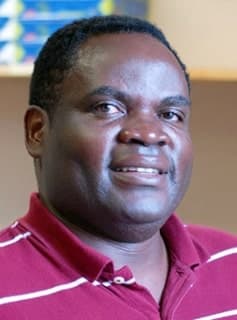
Born in 1965 into a family of seven children, fatherless at the age of 15, Vincent Machozi decided to join the Congregation at the age of 17. After studying theology in France and ordination in Angers in 1994, he was sent to teach at the seminary in Kinshasa, capital of DR-Congo. Father Machozi was president of the “Kyaghanda Yira” association – named after the Yira (or Nande) ethnic group, the majority in this part of North Kivu – which aims to defend the rights and lands of this people.
The Yira are a people of around four million who, since 2010, have been targeted by armed groups driving them off their land in order to exploit the coltan-rich subsoil. At its general assembly in February 2016, the Kyaghanda Yira association described these massacres as “genocide of the Yira ethnic group”.